




When the heat index pushes past 95 and your AC seems to run all day, it's normal to wonder if something's wrong. That worry usually leads people to a piece of advice they've heard somewhere: the "20 degree rule." Some folks swear by it like gospel. Others wave it off as a myth.
Both camps miss the point a little.
The 20 degree rule is less a law and more a helpful way to understand what your air conditioner can reasonably do on a brutally hot day, how much it costs to run, and how to stay comfortable without grinding your equipment into the ground.
What the 20 Degree Rule Actually Says

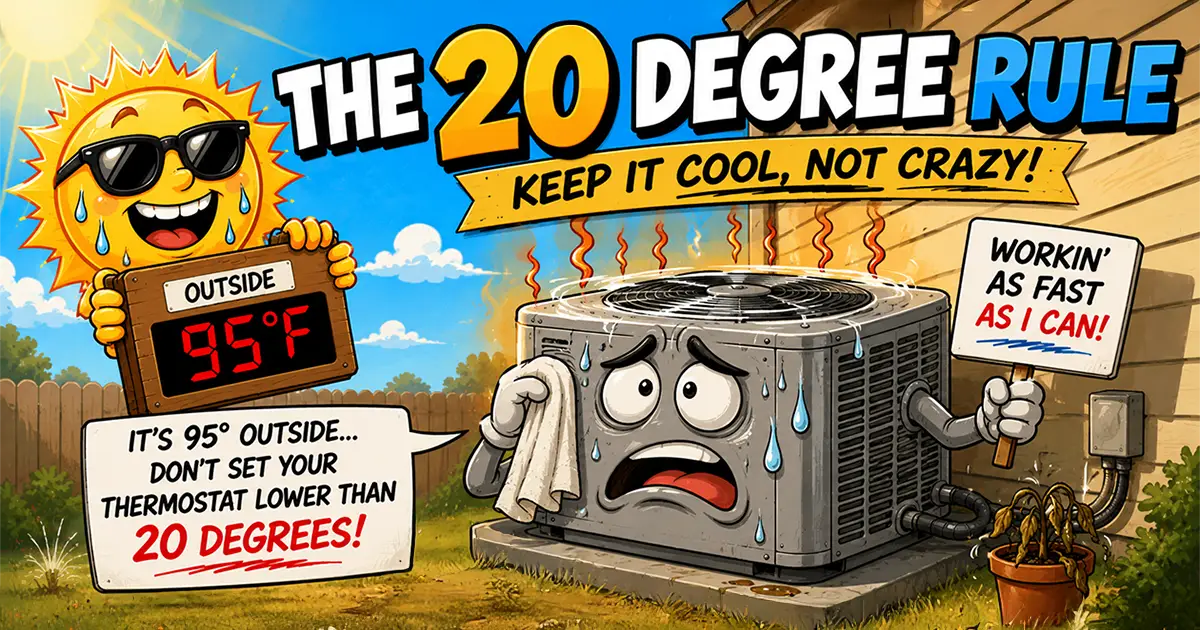
The idea is simple. Your thermostat shouldn't sit more than 20 degrees below the outdoor temperature. If it's 95 outside, setting the thermostat around 75 lands in sensible territory.
HVAC techs lean on this guideline because it matches how home cooling systems are built to run. An air conditioner pulls heat out of your house at a steady rate, and it can only move so much of it per hour. Widen the gap between the temperature inside and the temperature outside, and your system has to fight harder to hold the number you picked.
Equipment protection is only part of the story. The rule also helps you weigh three things that pull against each other: comfort, your power bill, and the long-term health of your system. Crank the thermostat far below what's happening outside and you invite nonstop runtime, a higher bill, and extra wear on the parts that matter most.
Why Your AC Can't Just Hit Any Number You Pick
A lot of people assume a healthy air conditioner should reach whatever temperature shows up on the thermostat. Home systems don't work like that.
An air conditioner is designed to cool the air passing through it by roughly 16 to 22 degrees. Techs call that figure Delta-T, or the temperature differential. So if 78 degree air enters the system, the air blowing out of your vents might land somewhere between 58 and 62.
Here's where people get tangled up.
The 20 degree rule compares your indoor temperature to the outdoor temperature. Delta-T compares the air going into the system to the air coming out of it. They're cousins, not twins. One measures the job your house is asking the AC to do, and the other measures what the equipment does in a single pass.
The hotter it gets outside, the more heat your AC has to haul out of the house, and every degree you drop the thermostat adds to that load.
So Is It a Hard Limit or Not?
This is the part that trips up the most people. Plenty of folks believe an air conditioner physically can't cool a home more than 20 degrees below the outdoor temperature. That's not true.
Under the right conditions, a system can absolutely hold an indoor temperature well past that 20 degree gap. Good insulation, properly sized and high-efficiency equipment, and lower humidity all stack the deck in your favor.
Think of the rule as an efficiency target, not a ceiling.
A capable system might keep your house at 70 while it's 95 outside. The real question isn't whether it can. It's how much electricity it burns and how much strain it takes to get there. When an AC runs flat out for hours, it pulls more power and leans hard on the compressor, blower motor, and capacitors. Repeat that day after day through a long summer and you shorten the equipment's life while raising the odds of a repair call.
What Happens If You Ignore It
Setting the thermostat too low during a heat wave creates a chain reaction.
The first thing you'll notice is the cost. Air conditioners run most efficiently inside their design range, and pushing past it means longer runtimes and bigger bills. A system that usually cycles on and off through the day can end up running almost without a break when it's chasing an aggressive setting. That difference shows up fast on your next statement.
Wear is the quieter problem. Constant operation keeps stressing the mechanical and electrical parts, which raises the chance of a breakdown and trims years off the system's life.
Humidity gets worse, too. An overworked AC can fall behind on pulling moisture out of the air, and a damp 72 degree house feels stickier and warmer than the thermostat suggests. If your unit never seems to shut off when it's hot out, that's a sign it's working harder than it should have to.
Staying Cool Without Touching the Thermostat
Temperature isn't the only thing that decides whether you feel comfortable. A few low-effort moves help your home feel cooler while letting your AC catch its breath.
- Set ceiling fans to spin counterclockwise during summer to create a wind-chill effect that can make a room feel several degrees cooler.
- Close blinds, shades, or curtains during the hottest part of the day to reduce solar heat gain.
- Use ovens, stoves, dryers, and dishwashers during early morning or evening hours to reduce indoor heat buildup.
- Seal gaps around windows and doors to keep conditioned air inside and hot air outside.
- Keep filters clean and vents unobstructed to maintain proper airflow throughout the home.
Getting Smarter About Thermostat Settings
How you run the thermostat does a lot of the heavy lifting on both comfort and cost.
Here at Brad's Heating & Air, we suggest keeping it between 75 and 78 while you're home. That window keeps the house comfortable for most people without running up the bill. When you head out, bumping it to 80 or 85 cuts cooling costs and still keeps the house from turning into an oven by the time you're back.
A smart thermostat handles all of this for you. Many models learn your daily rhythm and make small adjustments on their own, trimming energy use without you ever thinking about it.
One myth worth killing: dropping the thermostat way down does not cool your house any faster. Your AC cools at the same steady pace no matter how low you set the number. Setting 65 when you want 72 just means the system overshoots and runs longer than it needed to. A programmed schedule gets you comfort when you're home and savings when you're not.
When It's Time to Call Us
Some cooling trouble has nothing to do with the weather or your settings.
If your AC can't hold a reasonable temperature even when you're playing by the 20 degree rule, it's worth calling Brad to look at it.
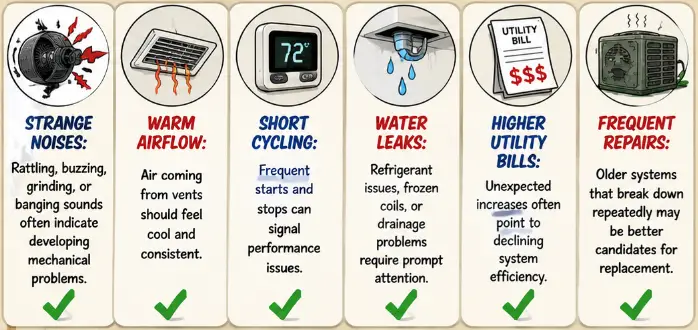
- Strange noises: Rattling, buzzing, grinding, or banging sounds often indicate developing mechanical problems.
- Warm airflow: Air coming from vents should feel cool and consistent.
- Short cycling: Frequent starts and stops can signal performance issues.
- Water leaks: Refrigerant issues, frozen coils, or drainage problems require prompt attention.
- Higher utility bills: Unexpected increases often point to declining system efficiency.
- Frequent repairs: Older systems that break down repeatedly may be better candidates for replacement.
For an older unit that breaks down every season, replacement frequently beats another repair. Newer high-efficiency equipment delivers better comfort, lower monthly costs, and far fewer surprises.
If your system's giving you trouble, contact us today at (501) 330-8066.
Final Thoughts
The 20 degree rule earns its place because it gives homeowners a realistic sense of what their AC can pull off when the weather turns punishing. It isn't a wall, and your system isn't broken if it cools past that mark on a good day. The number just captures the trade-off between staying comfortable, keeping bills in check, and helping your equipment last.
Pair sensible thermostat settings with ceiling fans, closed blinds, decent insulation, and regular tune-ups, and your AC has everything it needs to do its job well all season. Keep it running inside its comfort zone and you'll get a cooler house, a smaller bill, and a system that sticks around for years.